What is creative development?
Creative development sits between design and frontend engineering. A standard build asks whether a page works and loads quickly. Creative development also asks whether the interaction itself communicates: a transition that shows how two states relate, a scroll sequence that reveals a product in the right order, a shader that gives a brand its own texture.
It is written in code, not assembled from presets: animation timelines, scroll and pointer logic, Three.js or custom WebGL scenes, and the fallbacks that keep them dependable on ordinary phones. If you want an Awwwards-style site, this is the service, though we design for your visitors rather than a jury and never promise awards.
What a creative development project includes
The proposal names which of these deliverables are in scope, who supplies each input and how each one is accepted. Bring an approved design from your own designer or another studio, or ask Dardo to design and build it together.
- Interactive concept and prototype that answers the risky questions before the full build
- Scroll and pointer interactions with touch and keyboard equivalents
- A motion system: timing, easing and transitions reused across the site instead of one-off effects
- Performance budgets and fallbacks for reduced motion, slow connections and devices without WebGL
- Responsive implementation tested on the phones and browsers your audience actually uses
When motion helps, and when another service fits better
Creative development works when an interaction clarifies the product, demonstrates a system or gives a brand a memorable rhythm. We define that job first and storyboard the sequence as still frames. If the story doesn't work without motion, animation won't rescue it.
If visitors need to rotate an object or move through a space, our interactive 3D websites service is the closer fit. If you need a clear, well-built site with restrained motion, start with custom web design. A single campaign offer usually belongs on a landing page.
How a project runs: one working slice first
Before estimating the whole experience, we build a representative slice: one real scene with real content, its static fallback and the main action, at the target screen sizes. It answers the expensive questions early. Is the idea clear without instructions? Does it work on a phone? What happens when assets load slowly? Can someone reach the main action without finishing the effect?
The slice comes with a written acceptance record of the agreed devices, asset sizes, keyboard and touch states, reduced-motion behavior and open risks. The full proposal then prices asset production, implementation, integrations, compatibility checks and support as separate lines you can compare.
Performance, accessibility and reduced motion
We budget initial assets, rendering work and interaction latency, and target Google's Core Web Vitals thresholds (largest contentful paint within 2.5 seconds, interaction to next paint within 200 milliseconds, layout shift of 0.1 or less) on representative devices rather than a desktop demo. Headlines, copy and links ship as HTML first, so the content never depends on the effect running.
With reduced motion turned on, visitors get a coherent version of the same story: parallax and camera moves become cuts or steps they control. Hover effects have touch and keyboard equivalents, and focus stays visible. Analytics can show whether people reach the action; it can't prove an animation caused a sale.
Work you can inspect: Hyper and Janus Observatory
Hyper is a product story Dardo designed for an AI customer-intelligence concept. Motion connects customer signals to a unified profile and that profile to a suggested offer, so each transition explains a change in meaning. It is a concept: its interactive prototype, a Next.js interface backed by a Python FastAPI prototype, runs on synthetic examples, and we claim no conversion or customer results.
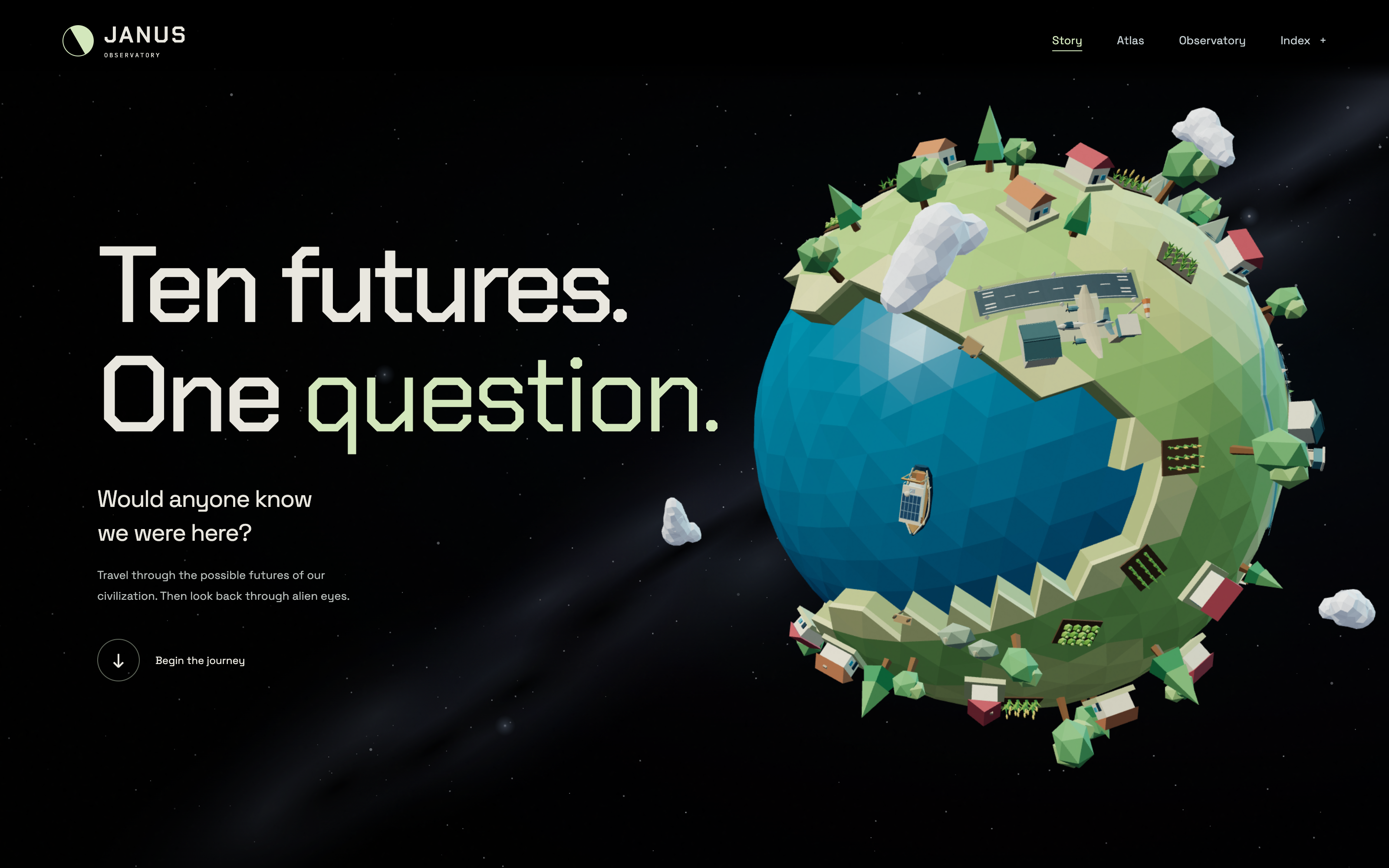
Janus Observatory is a research experience developed with Blue Marble Space: a cinematic opening, an atlas of ten possible futures and an observatory for comparing them. Labels and explanations live outside the 3D layer, and the build is held to bundle budgets, browser QA and release checks for visual regressions. It demonstrates interactive delivery, not a client's commercial outcome.
What affects the cost of a creative website?
A creative scope is priced by the number of distinct scenes and sequences, whether illustration, 3D or video assets must be produced, whether the design is already approved, the devices to support, CMS and integration work, and post-launch support. The inquiry form asks for a budget band, from under USD 5,000 up to USD 60,000 and above, so the proposal can fit the scope to it.
Creative development for US and Latin American teams
Dardo is a team of three based in Bogotá, Colombia, led by founder Nicolás Cerón and working in English or Spanish. Bogotá is on UTC−5 all year, with working-day overlap for teams in the US and Latin America. We partner with design studios and in-house launch teams. The proposal names review owners, meeting overlap, handover language and repository ownership.
Questions before you choose
What does a creative developer do?
A creative developer is a frontend engineer who specializes in the experience layer of a website: motion, scroll and pointer interaction, WebGL and shaders. The job is to make those effects communicate while the page still loads quickly, works on phones and respects accessibility settings. At Dardo the same small team designs and builds, so the idea and its implementation are reviewed together.
How much does an animated or interactive website cost?
It depends on the work: the number of distinct scenes, the illustration, 3D or video assets to produce, whether the design is supplied and the devices to support. We quote after scoping a representative slice, so the price reflects your brief rather than a fixed package.
Do animations hurt SEO or page speed?
Not by themselves; poorly loaded ones do. Search engines read HTML, so the headline, copy and links must exist before any canvas or animation script runs. Heavy code should load after the first content appears, layouts should reserve space so nothing jumps, and animation shouldn't block input. We check Core Web Vitals on representative phones before launch, and we don't guarantee rankings.
Can an animated website meet accessibility standards?
Yes, if accessibility is designed with the motion rather than patched afterward. WCAG requires a way to pause, stop or hide content that moves on its own for more than five seconds, and recommends letting people turn off motion triggered by interaction. We honor the reduced-motion setting, keep focus visible and make sure no content depends on finishing an animation.
How long does a creative development project take?
There is no standard duration; it depends on the number of scenes, asset production and review cycles. We set dates in the proposal after scoping the first working slice, which also exposes the risks that tend to move timelines, such as heavy assets or interactions that need rethinking for touch. Share any fixed launch date at the start.
Should I choose creative development or an interactive 3D website?
Choose creative development when motion, scroll and transitions carry the story on an otherwise conventional page. Choose an interactive 3D website when visitors need to explore an object, place or system in three dimensions. Many projects mix both. The deciding question is whether the visitor's input changes what they learn, or whether a well-paced sequence explains it better.
From the blog
- Rive vs Lottie vs SVG vs video: how to animate a logo on a website
Four ways to put an animated logo on a website, and what each costs in weight, speed and accessibility, measured on the Rive logo we built for Gissi.
- 3D websites: when they're worth it and how to keep them fast
When a 3D website earns its place, when video or images work better, and how we kept Janus Observatory's ten 3D worlds fast, accessible and usable.