The research behind it
The scenarios come from a peer-reviewed paper by Jacob Haqq-Misra, George Profitiliotis and Ravi Kopparapu of the Blue Marble Space Institute of Science, published in Technological Forecasting and Social Change, with its arXiv version under a CC BY 4.0 licence. The paper models how Earth's technosphere could develop over a millennium and what signs of technology a distant observer could detect in each case. Ten futures in one site create a navigation problem: a plain list would be clear but would lose the spatial idea, and an uninterrupted 3D sequence would be striking but hard to compare.
What Dardo built
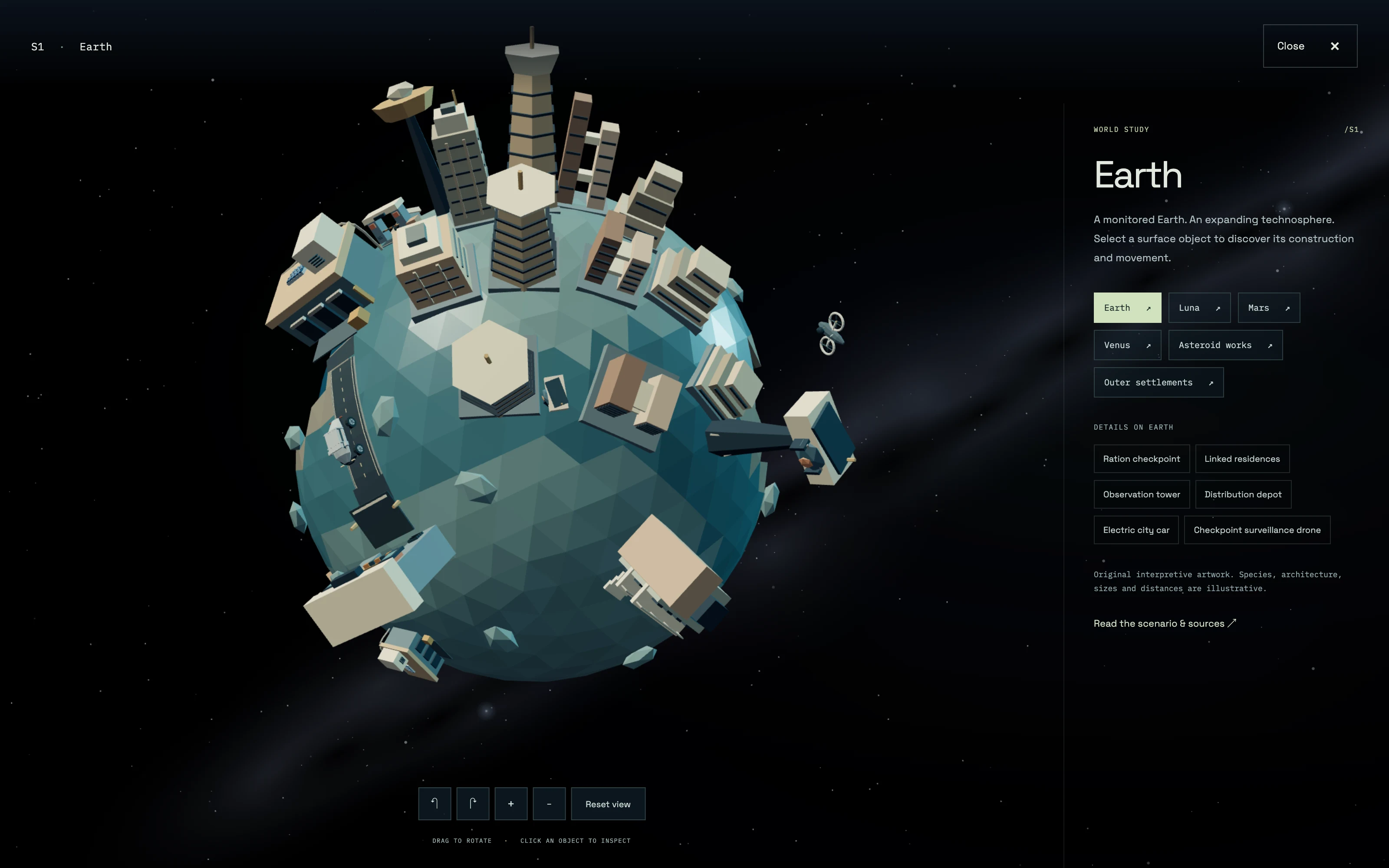
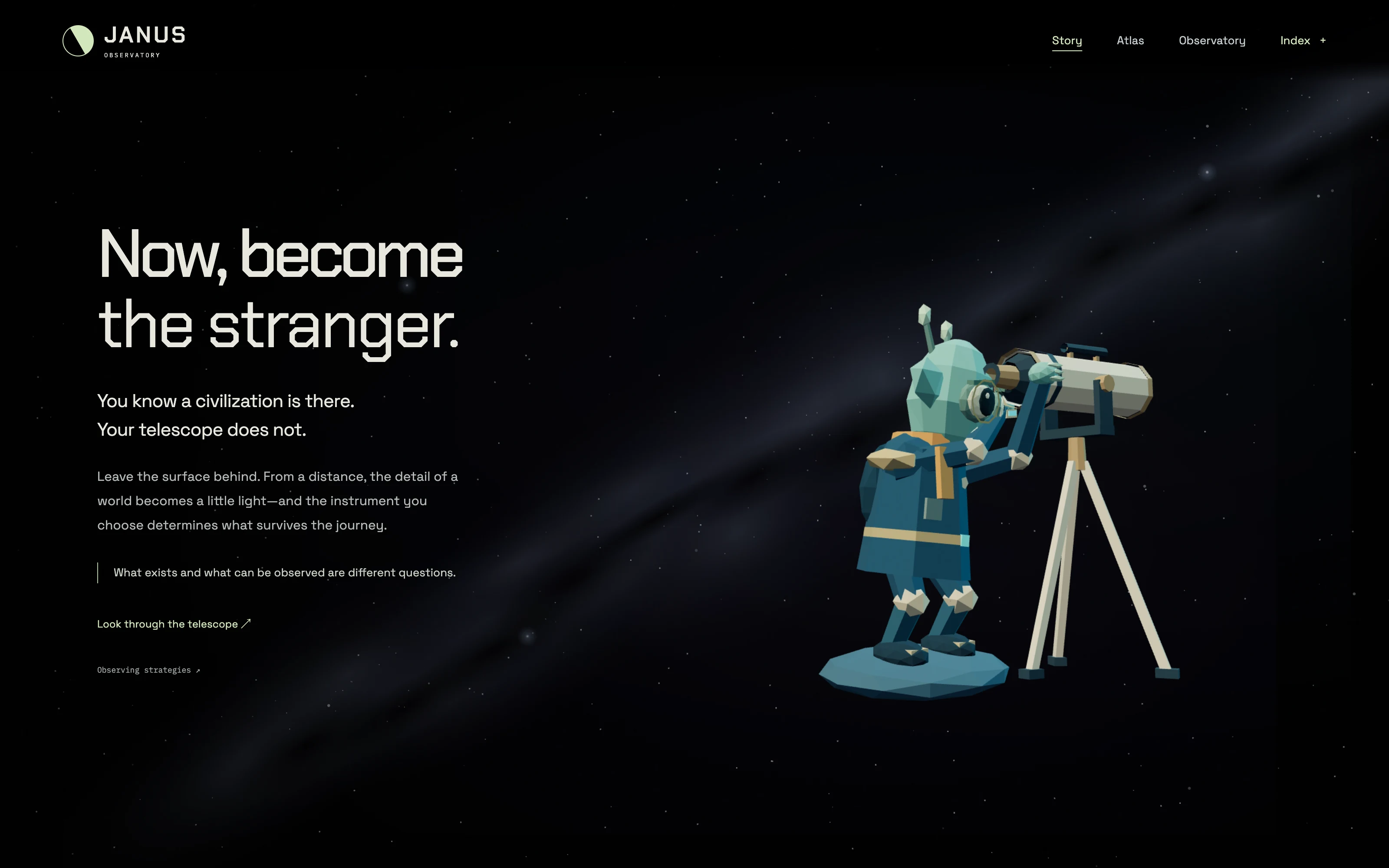
- The Story: 17 chapters that introduce the ten worlds one at a time, with an articulated alien astronomer and its telescope as the narrator's point of view.
- The Atlas: every scenario on its own page, with its data, a downloadable dataset in JSON and CSV, and comparisons between worlds.
- The Observatory: an instrument ladder that shows what each world would look like at increasing levels of detail, from a distant point of light to its surface.
- Research, Methods and Sources pages that cite every claim back to the paper and its data, with a provenance record for each dataset field.
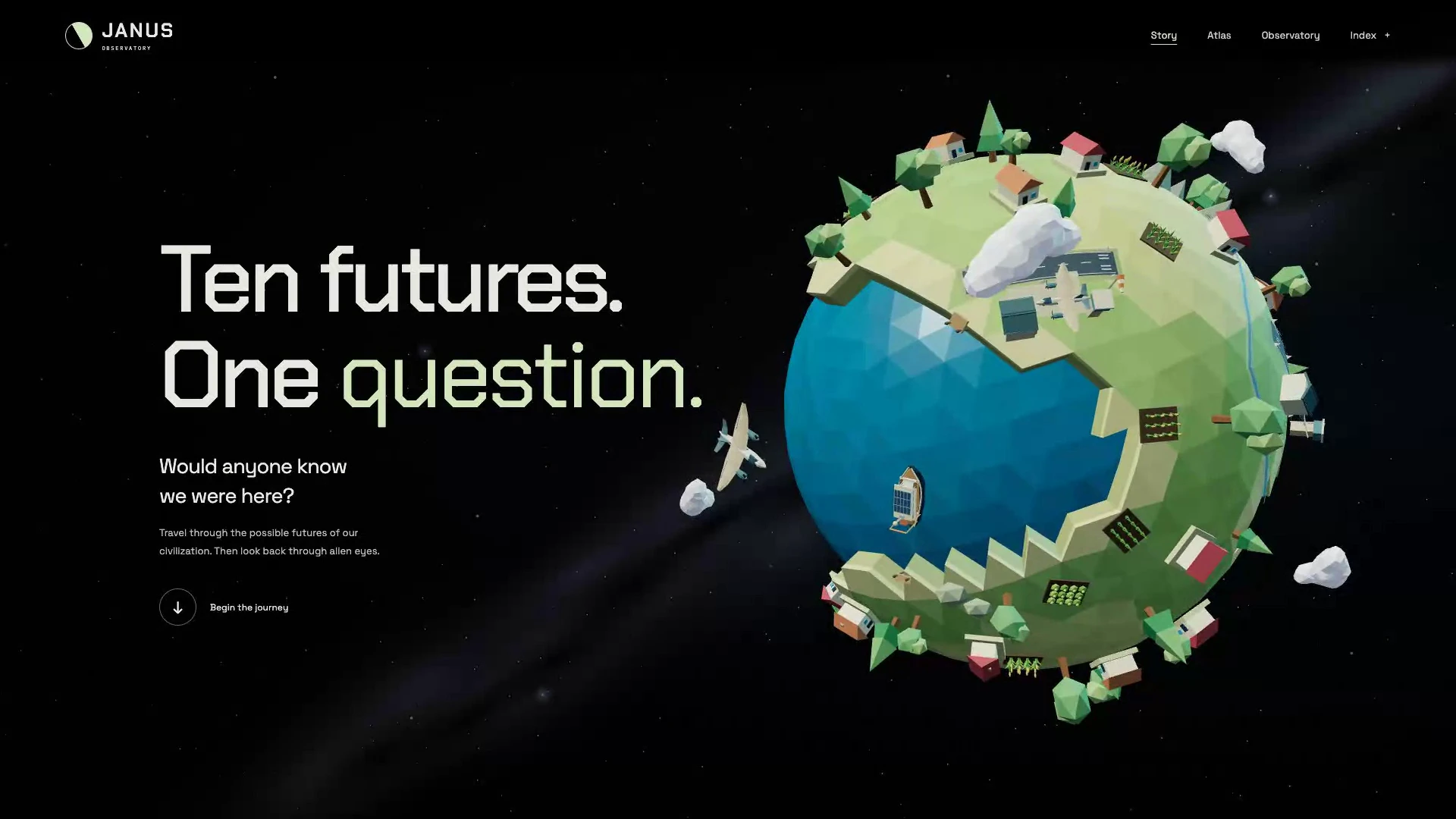
- Ten original low-poly worlds modeled for the project, plus an archive of fictional artifacts clearly labeled as illustrative.
Built to work without 3D
This is how we approach every interactive 3D website: the 3D layer adds meaning, and the page still works without it. The project's rule is that the core experience must work without WebGL and without AI. Every canvas has structured text and data behind it: all ten scenario records load with JavaScript turned off, the controls work without WebGL, and keyboard rotation, visible focus and reduced motion were built with each feature rather than added afterwards. The accessibility target is WCAG 2.2 AA, checked with axe-core in automated tests on Chromium, Firefox and WebKit.
Performance on a free hosting plan
Janus runs on Cloudflare Workers' free plan, which caps the size of the application. The release report of 27 September 2026 records what that took:
- The 59 3D models ship as gzip variants that total 8.2 MB instead of 15.8 MB, 47.9% less to download, with the original files kept for browsers that can't decompress them.
- Meshopt decoding runs on one background worker that shuts down after five idle seconds.
- Initial homepage JavaScript is 197,059 bytes gzipped, under a 256,000-byte budget.
- The Worker is 2,769.68 KiB against the free plan's 3,072 KiB limit, with a recorded startup of 43 ms.
- A speculative prefetch loop in the Next.js and OpenNext stack, which made 11,704 requests in one failed browser trace, was eliminated; the tests now require zero speculative requests.
Stack
The site is a Next.js 16 and React 19 app with three.js, React Three Fiber, GSAP and D3, deployed on Cloudflare Workers through OpenNext. A Python pipeline ingests the paper's data and generates eight canonical datasets with 1,361 field-level provenance records. The project keeps 35 written decision records explaining its technical choices.
Implementation evidence
On 12 October 2026 we checked the live experience and its Story, Atlas, Observatory, Research, Methods, Sources and Accessibility pages. The figures above come from the project's release report of 27 September 2026, which also records 127 passing unit tests, a public HTTP audit of 20 pages and all 59 model files, and a browser suite run on Chromium, Firefox and mobile WebKit.
Evidence and limits
The scenarios are explorations from published research, not forecasts. The site's scientific review is still pending, as its own pages state, and its AI research assistant is switched off in production. This page does not claim a frame rate on every device: the release report withdrew an earlier frame-rate figure that depended on lower rendering resolution.
Sources & further reading
Primary project evidence: the live deployment and implementation details reviewed by Dardo for this case.
- Janus Observatory live experiencejanus-observatory.nicocerond.workers.dev
- Janus Observatory sources and licencesjanus-observatory.nicocerond.workers.dev
- Accessibility: controls, nonvisual equivalents and limitsjanus-observatory.nicocerond.workers.dev
- Paper: Projections of Earth's Technosphere (Technological Forecasting and Social Change)doi.org
- The paper on arXiv (CC BY 4.0)arxiv.org