A 100-point procurement worksheet
Rate each criterion from zero to five, then multiply by its weight and divide by five. Keep untested criteria marked unknown. The weights are an editable buying example, not an objective world ranking.
| Criterion | Weight |
|---|---|
| Craft and art direction | 20 |
| Audience and content strategy | 15 |
| Comparable work and role | 15 |
| Scope and ownership | 15 |
| Mobile, access and performance | 10 |
| Process and review | 10 |
| Handoff and support | 10 |
| Language and delivery fit | 5 |
Record the project URL, proposal line or observed task supporting each score. A portfolio can show art direction; ownership and support need different evidence. Reweight the card for your project's actual risks.
- 01Need
- 02Evidence
- 03Trial
- 04Choice
Premium is a fit decision, not a badge
A bespoke website earns its cost when the business has a difficult point of view to express, a high-consequence decision to support, unusual content, several languages, or an interaction that a generic theme cannot explain. A template or AI-assisted build can be the better purchase when the task is familiar, the content is stable and the owner values speed, portability and low operating cost. “Premium” describes a level of attention and responsibility; it does not guarantee taste, conversion or search visibility.
Start by writing the situation in plain language: who needs to decide what, with which evidence, through which next step? A founder selecting a studio needs different proof from a family choosing music classes or a team comparing software. The studio should be able to show how the design makes that decision easier before discussing visual effects.
Define the need before the moodboard
GOV.UK’s user-needs guidance is useful procurement discipline: begin with the people who will use the service, write the need in their language, test assumptions and keep researching through later iterations. Adapt that approach to a commercial site. Write three or four needs such as “I need to compare two service options so I can request the right scope” or “I need to see what a first class includes so I can ask about availability.” Give each need a source, owner and acceptance test.
Now list the constraints that a visual direction must respect: existing routes, content owners, languages, legal or accessibility requirements, CMS, integrations, performance budget, launch date and inquiry destination. This prevents a studio from solving the visible layer while leaving the actual service unfinished. A striking home page cannot compensate for missing copy, an unowned domain or a form nobody verifies.
Use a weighted procurement scorecard
Score every candidate against the same 100-point card, and require evidence for each rating from zero to five. Weight relevant craft and art direction at 20 points; understanding of audience, content and strategy at 15; comparable work with a stated role and deliverables at 15; scope, ownership and commercial clarity at 15; mobile, accessibility and performance practice at 10; process, review rules and decision rights at 10; maintainability, handoff and support at 10; and language, location and inquiry-path fit at 5. Calculate each item as weight × rating ÷ 5, then record the URL, proposal line or observed test that supports it.
A score is evidence management, not a claim that one studio is objectively best. A portfolio image can support visual craft but not ownership or an accessible implementation. A fast prototype can support interaction thinking but not long-term maintenance. If a candidate refuses to state exclusions, cannot identify who writes the content, or provides only anonymous screenshots, score the evidence low and record why. Keep a separate “unknown” flag when a question was not tested; do not turn silence into a zero without noting the distinction.
Compare bespoke, template and AI-assisted work honestly
Ask what is actually bespoke. Is the studio creating a visual language, information hierarchy, interaction rules and responsive states for this audience, or applying a familiar template with new colors? A template can be a deliberate foundation when it is documented, accessible, fast and easy to edit. Bespoke work is justified when the content hierarchy, art direction or interaction must carry a distinctive idea that the foundation cannot express without distortion.
AI assistance belongs in the process question, not in a moral shortcut. Google says generative tools can help research or structure original material, while many pages without added value can violate scaled-content-abuse policies. Ask what was generated, what sources were checked, who edited the result and who owns the final claim. Do not award points for saying “no AI” without evidence, and do not penalize a tool that was used transparently and reviewed by the accountable team.
Read portfolio evidence as a chain
For each relevant project, ask for the brief, the studio’s role, the constraints, the shipped URL or approved artifact and the parts that remain unknown. A project gallery can show taste; a case study should show decisions. Ask why the page order changed, which content was supplied by the client, how the interface behaves on a phone, what was tested and who owns the current site. A result claim without a source, date or measurement is a marketing sentence, not procurement evidence.
Dardo’s public A medio tono page is a useful scope example because it names brand naming, web design, development and SEO, and describes a journey from an invitation to learn through instrument choice toward a first class. The official A medio tono site gives the product context: music classes offered virtually and at home in Bogotá and nearby areas, with instruments, age groups and a route to start. This supports an inspection of scope and design reasoning. It does not prove a ranking increase, enrollment result or revenue, and the case page does not establish that every current implementation detail was delivered by Dardo.
Test one real task before signing
Give finalists the same short brief and ask each to explain one representative page from content hierarchy to handoff. The test should include a phone width, a keyboard path, reduced motion, a language switch, a real inquiry destination and one content change by the owner. Ask for a small prototype or annotated direction, not a free full redesign. You are testing whether the team can make decisions visible and respond to constraints.
Use a review script: can the first screen state the audience and promise; can a visitor find proof and limits; does the primary action work; is the text present without JavaScript; are focus states visible; does the page remain understandable when images are slow; and can the owner edit a recurring fact? W3C’s WCAG 2.2 provides testable success criteria for accessible content, while web.dev’s Web Vitals reminds you to inspect real loading and interaction behavior. Record pass, partial or unknown with evidence.
Put ownership and acceptance in the contract
The contract should name the domain owner, hosting account, CMS, analytics property, source code, design files, fonts, images, translations and credentials. State when each transfers and what happens if the engagement ends. Define the content inventory, revision rounds, approval authority, change-request rate, defect period, support hours, third-party subscriptions and migration responsibility. “Unlimited revisions” is less useful than a decision rule for what counts as a revision and what becomes new scope.
Write acceptance tests in the same document: the agreed routes resolve, the key content is present in both languages, the form produces a durable receipt, keyboard and reduced-motion checks pass, and the owner can make the agreed edit. If AI or automation was used, record the responsibility and disclosure decision that matters to trust. An elegant launch with unclear ownership is a future procurement problem; a clear handoff is part of the design.
Choose after evidence, then keep measuring
Add the scorecard, prototype notes, proposal, source links and acceptance results to one decision record. Prefer the candidate whose evidence fits the actual risk, even if the visual direction is less theatrical. A premium bespoke choice should make the audience, point of view, proof, operating model and next action clearer. A template or AI-assisted choice should be able to make the same promises at lower cost and with an honest maintenance path.
Ask for the final brief in the buyer’s words: audience, content owners, languages, existing routes, constraints, deadline and business action. Invite the studio to state what it knows, assumes and will measure. The decision is defensible when another person can reproduce the comparison from the same evidence; the website is successful when people can complete the intended task and the owner can keep it truthful.
In practice / A medio tono
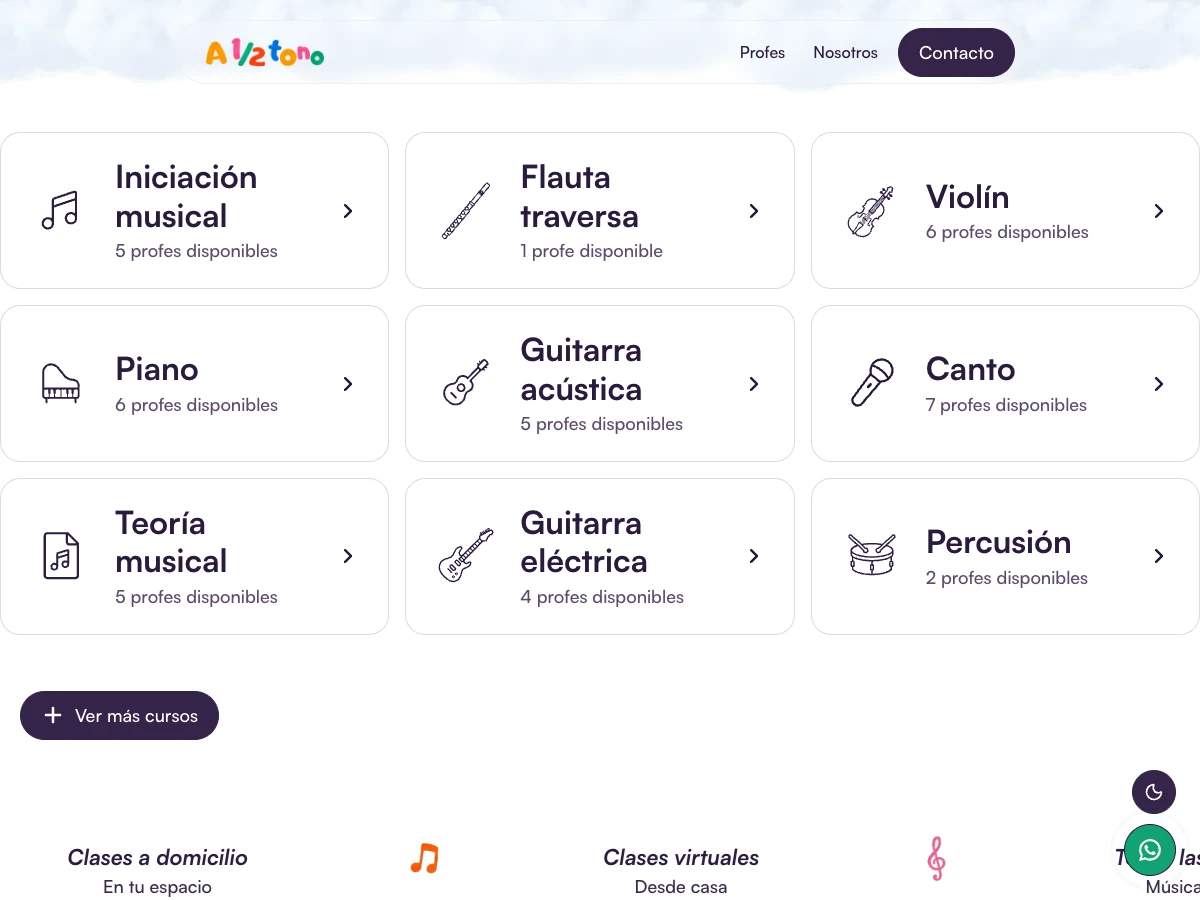
The name carries the musical association. This section does a more literal job: choose a teacher, start learning and understand weekly progress. Teacher cards connect an instrument to a person, while the three steps explain how to begin. These are visible design decisions, not proof of a conversion increase.
Explore the A medio tono projectSources & further reading
Sources behind this guide, with further detail from the original publishers.
- GOV.UK Service Manual: understand users and their needs
- GOV.UK Service Manual: plan user research
- Google Search Central: guidance on using generative AI content
- Google Search Central: spam policies
- W3C: Web Content Accessibility Guidelines 2.2
- web.dev: Web Vitals
- Dardo: A medio tono project scope
- A medio tono: music classes in Bogotá and online